


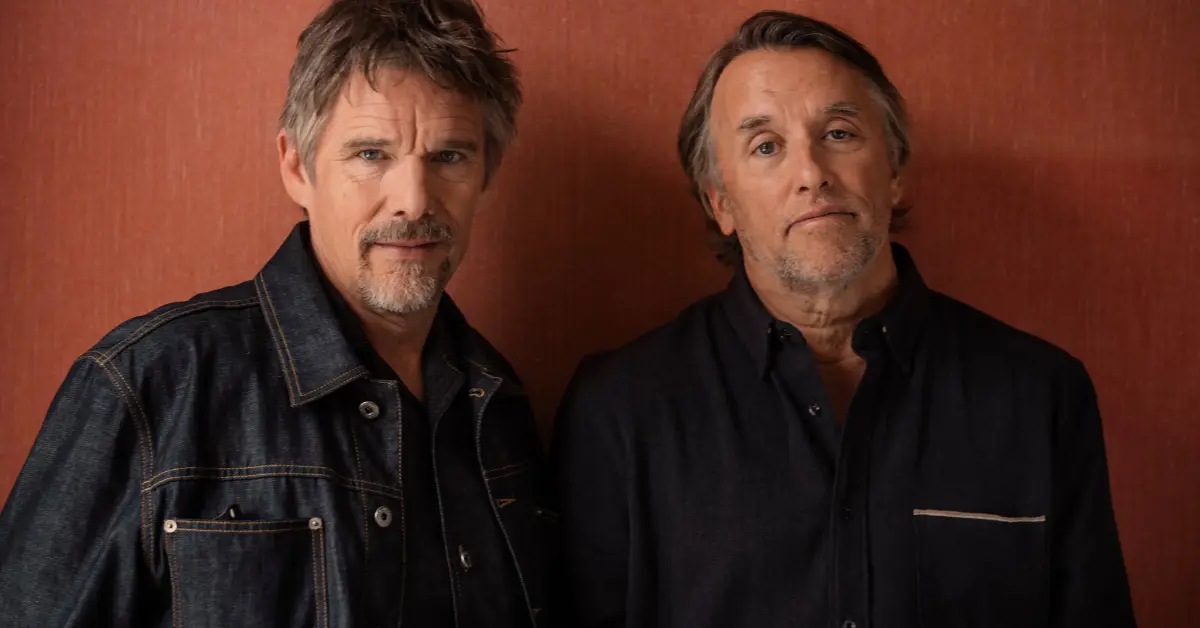
Explore how Ethan Hawke and Richard Linklater’s 32-year collaboration shaped Blue Moon and reinvented their filmmaking journey with passion, risk, and creativity.
Ethan Hawke & Richard Linklater: A 32-Year Conversation That Keeps Creating Cinema Magic
For more than three decades, Ethan Hawke and Richard Linklater have shared one of the most unique creative partnerships in American filmmaking. What began as a late-night backstage conversation in 1993 has evolved into a steady artistic bond—one that continues to shape some of modern cinema’s most intimate and emotionally resonant stories. Their latest collaboration, Blue Moon, proves that age and experience have only deepened the pair’s curiosity, courage, and willingness to take risks.
Their dynamic is so natural that during an interview in a London hotel suite, Hawke casually points to the armchairs and coffee table and remarks that the best part of this “press circus” is simply getting to sit in a room with Linklater again. After 32 years of working side-by-side, every new project feels like another chapter in one long, ongoing conversation.
A Partnership Forged in Curiosity
Hawke and Linklater first met while Hawke was performing in the play Sophistry. Backstage, they began talking—about art, life, ideas, everything. That single night of conversation laid the groundwork for Before Sunrise, the beloved 1995 romance that sent Hawke and Julie Delpy wandering through Vienna, exploring youth, love, and possibility.
That film launched a trilogy spanning nearly two decades. Before Sunset and Before Midnight followed the same characters at different stages in life, mirroring Hawke and Linklater’s own evolution. Through those films, audiences watched not just fictional characters grow older, but the maturing voice of a creative partnership built on trust and mutual respect.
Blue Moon: Their Biggest Swing Yet
Now comes Blue Moon, their 11th collaboration—and perhaps their boldest. Set in the glamorous but emotionally charged world of 1940s Broadway, the film follows lyricist Lorenz Hart on the opening night of Oklahoma! while his former partner Richard Rodgers celebrates with Oscar Hammerstein.
Unlike earlier Linklater–Hawke projects, this role demanded a full physical and emotional transformation. Hart was short, balding, and volatile. Hawke shaved his head, shot scenes in a trench to appear smaller, and embraced a performance far bigger and riskier than the understated characters he often plays for Linklater.
That shift created tension—not dramatic conflict but artistic pressure.
Hawke admits that at times he felt he was “hitting the wall” of his abilities. Linklater, unfazed, simply responded, “That’s the place where you want to be.”
For Hawke, it felt like skiing down a slope too steep: terrifying in motion, exhilarating once you land safely.
Read also… Rohit Sharma’s Hilarious DRS Banter with Kuldeep Yadav Lights Up India vs South Africa 3rd ODI
A Little Indie Spirit Behind the Glamour
Despite its vintage shine, Blue Moon was made with scrappy independent-film determination. The entire movie was shot in just 15 days on an Irish soundstage dressed up as Manhattan. That speed and resourcefulness reflect the duo’s shared roots. Even now, after decades in the industry, they continue to work with the energy of filmmakers just starting out.
And that’s part of what keeps their partnership strong: neither outgrew the other. Both carved out successful careers, but neither soared so high that the collaboration started feeling like an obligation.
As Hawke jokes, their “underachieving careers” have been a blessing. They stayed on the same level—close enough to keep meeting each other as equals.
Artistic Breakups, Addiction, and the Cost of Talent
The film’s emotional core—Hart’s decline—resonates with Linklater and Hawke on a deeper level. Both have known gifted artists whose lives were overshadowed by addiction. Hawke worked alongside River Phoenix, Robin Williams, and Philip Seymour Hoffman, all of whom were later framed as tragic figures.
But Hawke pushes back on that narrative. Yes, they struggled. But they also lived, created, laughed, and triumphed—far more than their final moments suggest.
When discussing Hoffman, Hawke emphasizes how many days the actor won his battle with addiction: “He lost one day. But he won all the others.”
Linklater adds that both extreme failure and extreme success can break a person. Too much of either, and the pressure becomes unbearable.
Keeping Curiosity Alive
If there’s one thing that sets Hawke and Linklater apart, it’s that they’ve never lost their sense of curiosity. Linklater bristles at the idea that aging naturally leads to cynicism. Hawke argues that cynicism is what happens when curiosity dies—when the industry beats the idealism out of you.
Yet here they are, deep into their careers, making a 15-day indie film with the enthusiasm of newcomers.
To Hawke, that refusal to see independent filmmaking as the “minor leagues” is exactly why Linklater remains vital.
The Conversation That Never Ends
As they sit in their press-junket suite, surrounded by cameras and schedules, Hawke gestures around the room and smiles. For him, the setting itself represents the real magic: another chance to talk, debate, collaborate, and dream with someone who has shaped his creative life for more than three decades.
For Linklater and Hawke, the films are almost secondary. The real art is the conversation—the one they’ve been having since 1993, and the one that continues every time they step into a room together.