


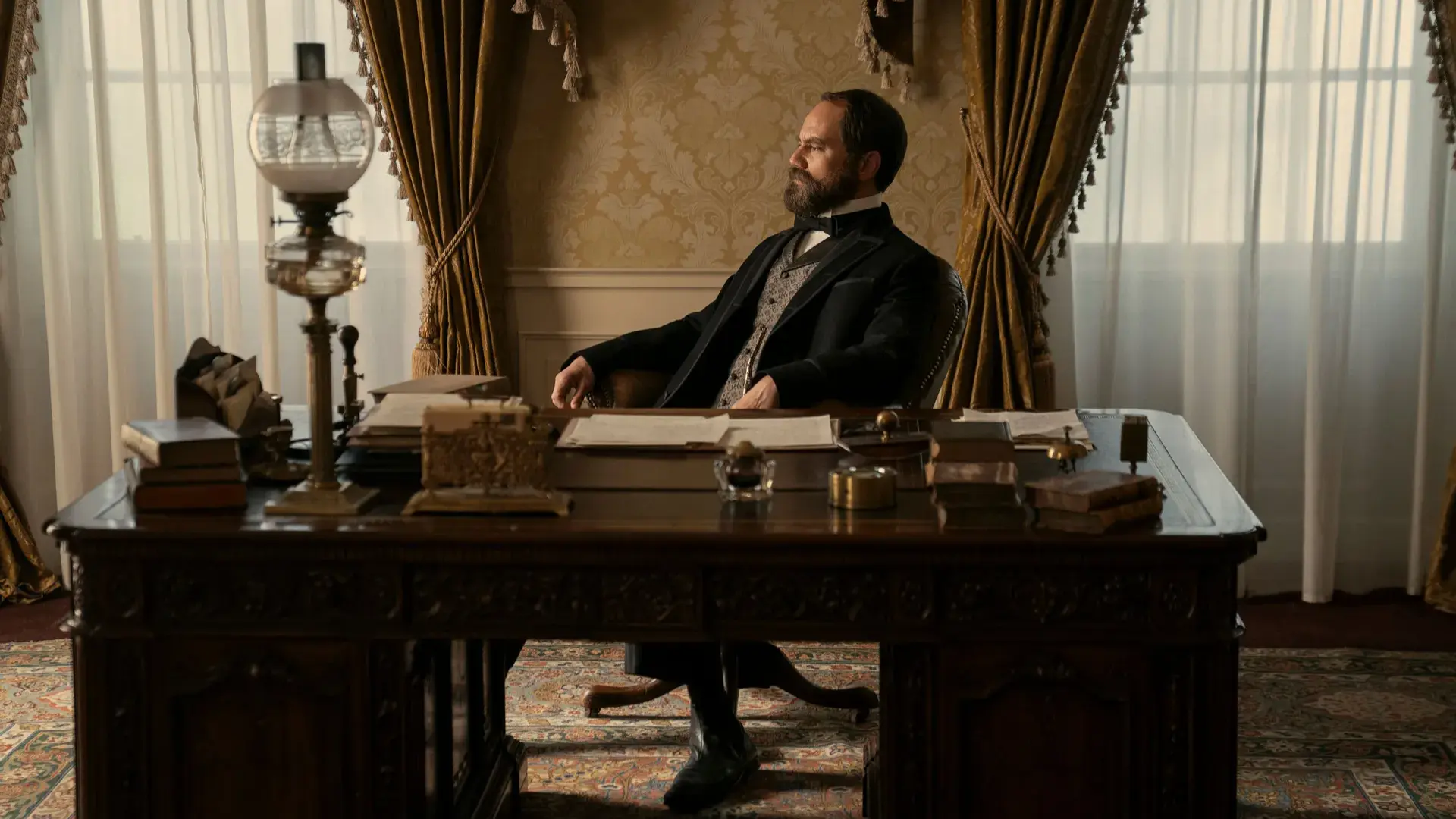
The new miniseries “Death by Lightning” explores James Garfield’s unexpected rise to the presidency and his moral leadership in a corrupt era. Read a full, 800-word review and analysis.
Death by Lightning” Revisits the Rise—and Tragedy—of James Garfield, the Reluctant President America Needed
American history is full of leaders who clawed their way to power, fueled by ego, ambition, and the relentless pursuit of influence. That’s why the myth of the selfless politician—the person who doesn’t seek power but is handed it because of merit—continues to charm voters. The new limited series “Death by Lightning” taps into this enduring fantasy through the story of James A. Garfield, a man who might have embodied that ideal more than any other figure in U.S. politics.
Starring Michael Shannon in a sublime performance, the series examines how Garfield, an unassuming Ohio congressman with little national prominence, became the Republican nominee for President in 1880 almost by accident. His rise wasn’t the result of scheming or hunger for authority. Instead, it began with a speech—one so impassioned, honest, and morally grounded that it left the Republican National Convention stunned. While Garfield only intended to nominate another man, he became, in that instant, the party’s unexpected favorite.
A Party in Disarray—and Ready for a Change
The show frames the 1880 election as a pivotal moment for the Republican Party. Fifteen years after the Civil War, the once-reformist GOP had grown comfortable with power, sliding deeper into machine politics and internal corruption. Factions split the party into feuding camps, each motivated more by patronage and personal gain than by ideology.
Yet even political operatives can tire of their own excesses. As the series notes, some high-ranking Republicans grew frustrated with what their party had become. “We’re the party of Lincoln,” one character says. “We ought to live up to it for once.” This sentiment becomes the emotional backbone of the series, reflecting a yearning for ethical leadership that feels strikingly familiar today.
Garfield, portrayed as a principled idealist, walks into this environment almost by chance. He is not a power broker. He is not a manipulator. He is, in fact, someone who explicitly does not want the nomination. But in the face of a fractured party searching for redemption, his sincerity resonates more strongly than calculated ambition ever could.
Michael Shannon’s Garfield: A Leader Who Never Asked to Lead
Shannon plays Garfield with a quiet force—humble yet commanding, moral yet pragmatic. His interpretation highlights the tension between Garfield’s reluctance and the undeniable charisma that gradually pulls him into the center of national politics.
The show doesn’t romanticize Garfield as a saint. Instead, it depicts him as a deeply human, thoughtful, often conflicted figure. But compared to the era’s typical political operators, he is refreshingly principled. His story challenges the modern assumption that power always attracts the most power-hungry people.
Garfield’s rise feels almost miraculous, but the series emphasizes that it resulted from a unique convergence of circumstances: a divided party, a country still recovering from civil war, and the desperation for someone untainted by corruption.
A Nation Still Healing from Civil War Fault Lines
While “Death by Lightning” focuses on Garfield the man, it also paints a vivid portrait of America during Reconstruction’s final years. Regional tensions remained raw, racial inequality was deeply entrenched, and political violence simmered beneath the surface.
Against this unstable backdrop, Garfield’s nomination symbolized hope for a return to moral leadership. He represented the possibility that postwar America could still choose integrity over chaos. The show does a compelling job connecting the country’s unrest to the hunger for a leader who could restore some sense of honor to national politics.
The Tragedy That Shadowed His Presidency
Though the series primarily examines his unexpected rise, viewers familiar with history will sense tragedy looming over every episode. Garfield became one of America’s shortest-serving presidents, struck down by an assassin just months into his term. His death would become a turning point in American politics, exposing systemic flaws and pushing the country toward civil-service reform.
“Death by Lightning” doesn’t rush to the assassination. Instead, it carefully builds the emotional weight by showing the promise of what Garfield could have been—a reformer, a healer, a unifier in an era that desperately needed one. By the time the tragedy unfolds, it feels not just historically significant but personally devastating.
Themes That Resonate Today
Although set in the 19th century, the series draws powerful parallels to the present:
- A political party wrestling with its identity
- Leaders driven more by loyalty networks than the public good
- Voters yearning for authenticity
- A fractured nation searching for moral clarity
Garfield’s accidental rise serves as both inspiration and caution. It challenges viewers to imagine whether a reluctant but honorable leader could still emerge in today’s political climate—or whether our systems have drifted too far from allowing such a figure to thrive.
A Compelling, Thoughtful Retelling
“Death by Lightning” succeeds as both historical drama and political commentary. It’s richly acted, beautifully paced, and deeply invested in understanding why Garfield mattered. Instead of being a footnote president, he emerges as a symbol of a different kind of leadership—one rooted not in ambition but in character.
For viewers drawn to stories of political intrigue, moral struggle, and forgotten history, the miniseries offers a gripping and surprisingly emotional journey. And for anyone exhausted by modern politics, Garfield’s story serves as a reminder that integrity in leadership, while rare, is not a myth. It has existed before—and it might exist again.