


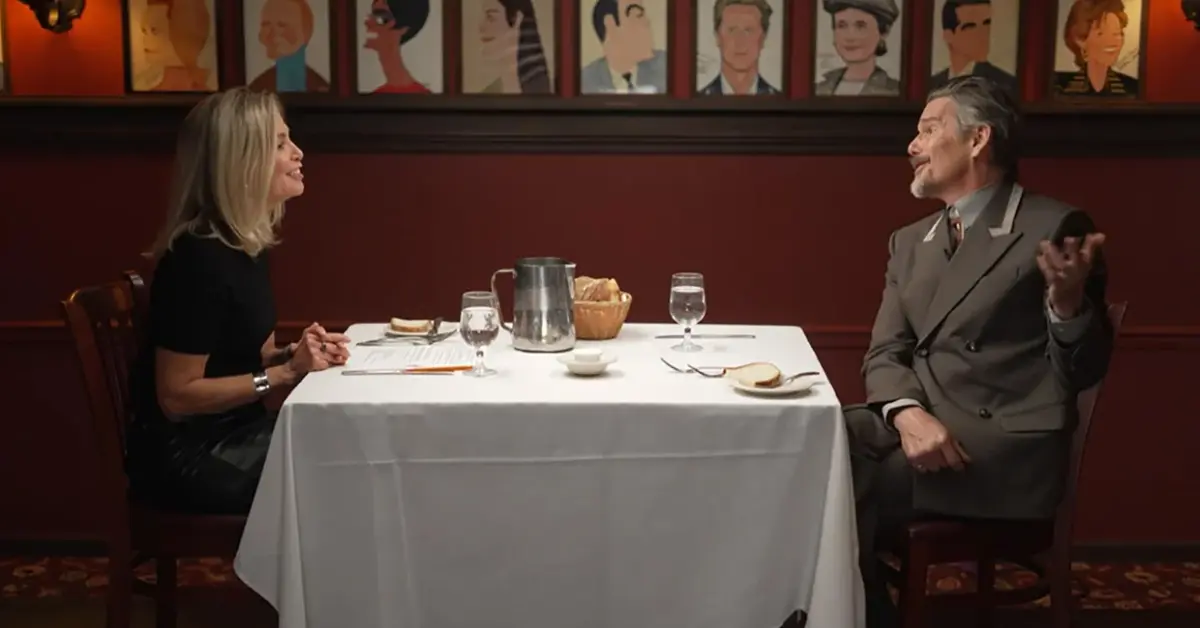
Ethan Hawke delivers a powerful performance as Lorenz Hart in “Blue Moon,” earning awards buzz and finally securing his portrait at Sardi’s. A new chapter begins.
Ethan Hawke Steps Into the Spotlight Again With “Blue Moon,” Bringing New Life to Broadway Legend Lorenz Hart
Nearly a century ago, composer Richard Rodgers and lyricist Lorenz Hart helped shape what we now call the Great American Songbook. Their unforgettable classics—“My Funny Valentine,” “Blue Moon,” and “The Lady Is a Tramp”—still echo through American culture. Yet behind the brilliance was a troubled partnership, one that dissolved as Hart’s personal struggles deepened. By the early 1940s, Hart’s drinking made collaboration nearly impossible, prompting Rodgers to seek a new partner: Oscar Hammerstein II. Their first musical, Oklahoma!, opened on March 31, 1943, and forever changed Broadway.
But that same night, as celebrations roared at Sardi’s—Broadway’s legendary restaurant known for its celebrity caricatures—Lorenz Hart arrived alone, heartbroken and battling demons. That poignant moment is now at the center of the new film Blue Moon.
In the movie, Ethan Hawke transforms into Hart, portraying the lyricist’s pain, wit, sadness, and brilliance. While the film recreated Sardi’s on a soundstage, Hawke visited the real restaurant for CBS Sunday Morning, reflecting on how this role stretched him creatively.
“I would walk in here as a young person thinking, ‘When am I gonna get my picture up there?’” Hawke confessed, gazing at the iconic walls. With a smile, he added, “My time’s coming. I’m not done yet!”
As it turns out, he was right—more on that later.
Transforming Into Lorenz Hart
Hart was famously short—under five feet. Hawke, who is nearly six feet tall, had to undergo a physical transformation. Director Richard Linklater, Hawke’s longtime collaborator, used clever camera tricks to shrink the actor on screen. Hawke committed even further: he shaved the top of his head to create an authentic comb-over and memorized a staggering amount of dialogue.
“It’s definitely the most text I’ve ever had in a movie,” Hawke revealed. “I think I had more lines than I had in the previous five films combined.”
For an actor whose power often comes from subtle expressions rather than lengthy monologues, it was a new kind of challenge—and one he embraced fully.
Read also… Paramount Challenges Netflix With Bigger All-Cash Bid for Warner Bros. Discovery
Lessons From Robin Williams and a Lifetime in Acting
Hawke’s career stretches over three decades, beginning with his breakthrough role in Dead Poets Society in 1989. Acting alongside Robin Williams shaped him deeply. Hawke recalled one moment from filming—Williams guiding students through tearing pages from a poetry book—which he later realized was a lesson in artistic freedom.
“He taught me not to worry about rules,” Hawke said. “If someone doesn’t like it? Suck an egg. Nobody knows what great acting is any more than you do.”
That wisdom stayed with him through highs and lows. Hawke admits that starring in a hit film at 18 can be both a blessing and a burden. A young actor might think success defines the future—but Hawke knew he couldn’t allow early fame to become the peak of his career.
After Dead Poets Society, he debuted on Broadway in Chekhov’s The Seagull. Critics called his performance “promising,” noting that greater work lay ahead—a prophecy that proved true.
Oscars, Aging, and Finding New Purpose
Hawke earned his first Oscar nomination for Training Day (2001), starring alongside Denzel Washington. The film’s cultural impact still surprises him.
“My son was six when he asked me, ‘Dad, what’s Training Day?’ He said people kept saying it when they walked past me on the street.”
But after several major roles, Hawke intentionally turned down projects that didn’t speak to him creatively. Hollywood is notoriously unkind to actors as they age, and he soon felt opportunities slow down.
“You don’t realize there’s a shelf life,” Hawke said, admitting it hit around the time he spotted gray in his beard.
Fortunately, those silver strands now suit him. Hawke stars in FX’s acclaimed series The Lowdown, playing a hard-nosed investigative reporter with a gritty edge—another testament to his versatility.
A Career Moment at Sardi’s
As the interview wrapped up at Sardi’s, Hawke was given a surprise he had dreamed of since his youth. Owner Max Klimavicius approached and said, “Ethan, I would like your permission to make you part of our collection.”
Hawke was shaken—not by the camera tricks, not by Oscar chatter, but by this genuine honor.
“Wow! It finally happened,” he exclaimed. “I’ve got my portrait at Sardi’s. I’ve arrived!”
The moment brought full circle the joke he made earlier: his time really had come.
Oscar Buzz for “Blue Moon”
With Blue Moon earning critical praise, awards season buzz is swirling. Hawke tries not to let it consume him, but he admits it would be meaningful.
“I dedicated my life to this job,” he said. “It would be amazing.”
Yet he keeps perspective. Hawke shared a childhood memory—asking his mother what would happen in his life. She responded by singing “Que Sera, Sera.”
“You have to have a little ‘Que Sera, Sera’,” he reflected. “I don’t take any of it for granted.”
A New Chapter for a Timeless Artist
Ethan Hawke has had many eras—movie star, stage actor, writer, director, mentor, collaborator. But Blue Moon marks a fresh chapter. It’s a performance rooted in vulnerability, courage, and a genuine love for storytelling.
And now, with his portrait officially hanging on Sardi’s walls, Hawke’s legacy has been etched into Broadway history—right where he always hoped it would be.