


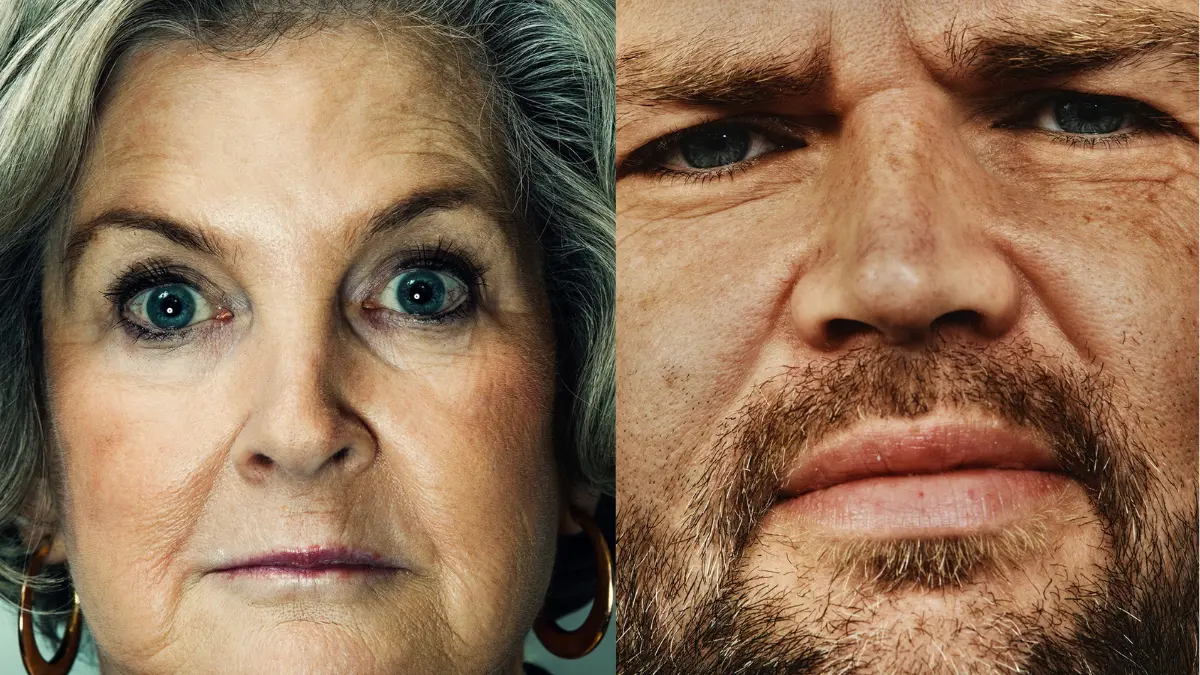
Vanity Fair’s extreme close-up portraits of Trump administration officials ignited social media backlash and debate. Photographer Christopher Anderson explains the artistic intent behind the images.
When Vanity Fair published a series of extreme close-up portraits of key White House figures from the second Trump administration, social media reacted instantly—and intensely. The photos, shared on the magazine’s Instagram page, showed every freckle, wrinkle, stray hair, and makeup smudge on some of the most recognizable faces in American politics. For many viewers, the images were startling, even uncomfortable. Words like “jump scare,” “mugshot,” and “warning please” appeared repeatedly in the comments section.
The portraits featured White House Chief of Staff Susie Wiles, Press Secretary Karoline Leavitt, Vice President JD Vance, Secretary of State Marco Rubio, Deputy Chief of Staff for Policy Stephen Miller, Director of the Presidential Personnel Office Dan Scavino, and Deputy Chief of Staff James Blair. Accustomed to carefully controlled public appearances, these figures were suddenly presented without the usual polish, filters, or flattering distance.
Despite widespread speculation online, the photos were not intended to embarrass or expose the officials. According to photographer Christopher Anderson, the unfiltered approach is central to his artistic style—not a political statement.
Read also… Gil Gerard Dies at 82: Buck Rogers in the 25th Century Star Remembered for His Iconic Sci-Fi Legacy
The Photographer Behind the Images
Christopher Anderson is an award-winning photojournalist whose work has appeared in The New York Times, The New York Times Magazine, Esquire, and The Wall Street Journal. He is also the recipient of the prestigious Robert Capa Gold Medal for his coverage of Haitian immigrants sailing to the United States.
For Anderson, close-up portraiture is nothing new. In fact, it has long been a defining feature of his work, especially when photographing political figures.
“Very close-up portraiture has been a fixture in a lot of my work over the years,” Anderson explained. “I like the idea of penetrating the theater of politics.”
Anderson and his team spent a full day at the White House on November 13, meeting each subject in their offices. Using a medium-format camera and carefully controlled lighting, he photographed each official in the same visual style. The goal, he said, was consistency—not commentary.
Transparency Meets Reality
Ironically, Anderson’s approach closely mirrors one of the Trump administration’s most repeated claims: that it is “the most transparent administration in history.” The portraits, stripped of glamour, reflect a literal version of that promise. Still, for many viewers, the level of detail felt jarring.
Comedian Kelsey Darragh summed up the reaction with humor, commenting, “Jesus Christ a warning next time please,” under a photo of Press Secretary Karoline Leavitt.
Leavitt’s portrait, in particular, drew intense attention. At just 28 years old, she is the youngest press secretary in modern U.S. history and often serves as the administration’s most visible spokesperson. Her close-up image highlighted every pore and line, with some commenters speculating—without confirmation—about cosmetic procedures.
Within eight hours, Leavitt’s photo amassed more than 20,000 views and roughly 2,000 comments, far surpassing engagement on the other portraits. Leavitt has not publicly responded, and the White House declined to comment on the images when contacted.
Anderson acknowledged that he moved even closer for Leavitt’s portrait but denied any negative intent. “Above all else, I try to cut through the image that politics want to project and get at something more truthful,” he said.
Marco Rubio, Susie Wiles, and Public Perception
Secretary of State Marco Rubio’s portrait also sparked commentary. One Instagram user joked that the image looked like it had been taken with “the camera from the dermatologist that shows sun damage.” Anderson said the selected photos were simply the ones that best captured each subject’s personality. In Rubio’s case, Vanity Fair also chose a candid image of him gazing out a window to add emotional context.
The article accompanying the portraits focused primarily on Susie Wiles, the first woman to serve as White House chief of staff. Nicknamed the “Ice Maiden” by President Trump, Wiles offered unusually candid remarks about the administration in her interview, including describing Trump as having “an alcoholic’s personality” and claiming JD Vance had been a “conspiracy theorist for a decade.”
Those remarks caused immediate controversy. After publication, Wiles pushed back, calling the article “disingenuously false” and accusing Vanity Fair of taking her words out of context. While she disputed the written story, she did not directly address the photographs themselves.
Her portraits, featuring wide, intense eyes and carefully curled silver hair, prompted comments like “Mugshot” and “Are the close-ups bad on purpose?”—a question repeated across multiple posts.
Art, Politics, and Discomfort
For Anderson, discomfort is part of the process. He insists that his responsibility as a photographer is not to flatter but to honestly portray what he encounters.
“I see my job as a responsibility to portray what I encounter,” he said, even when the result feels awkward or confrontational.
That tension was evident when Stephen Miller reportedly approached Anderson after his photoshoot to gently remind him to be mindful of how he portrays his subjects. Anderson did not elaborate on the exchange but suggested it underscored the delicate balance between art and power.
Why the Photos Struck a Nerve
The viral reaction to Vanity Fair’s portraits reveals more than just surprise at unflattering angles. In an era dominated by filters, curated images, and controlled political branding, the rawness of these photos challenged expectations. They forced viewers to confront the humanity—and physical reality—of figures usually seen only through polished press photos and staged appearances.
Whether praised as honest art or criticized as unnecessarily harsh, the portraits succeeded in one undeniable way: they made people look, react, and talk.
And in today’s political and media landscape, that alone ensures they will be remembered long after the initial shock fades.